Internship Program — Vadodara

Learn to build the web, one commit at a time.

Martian Technocrats runs a hands-on internship for students who want real project experience in programming languages, web development and search engine optimization — not just recorded lectures.

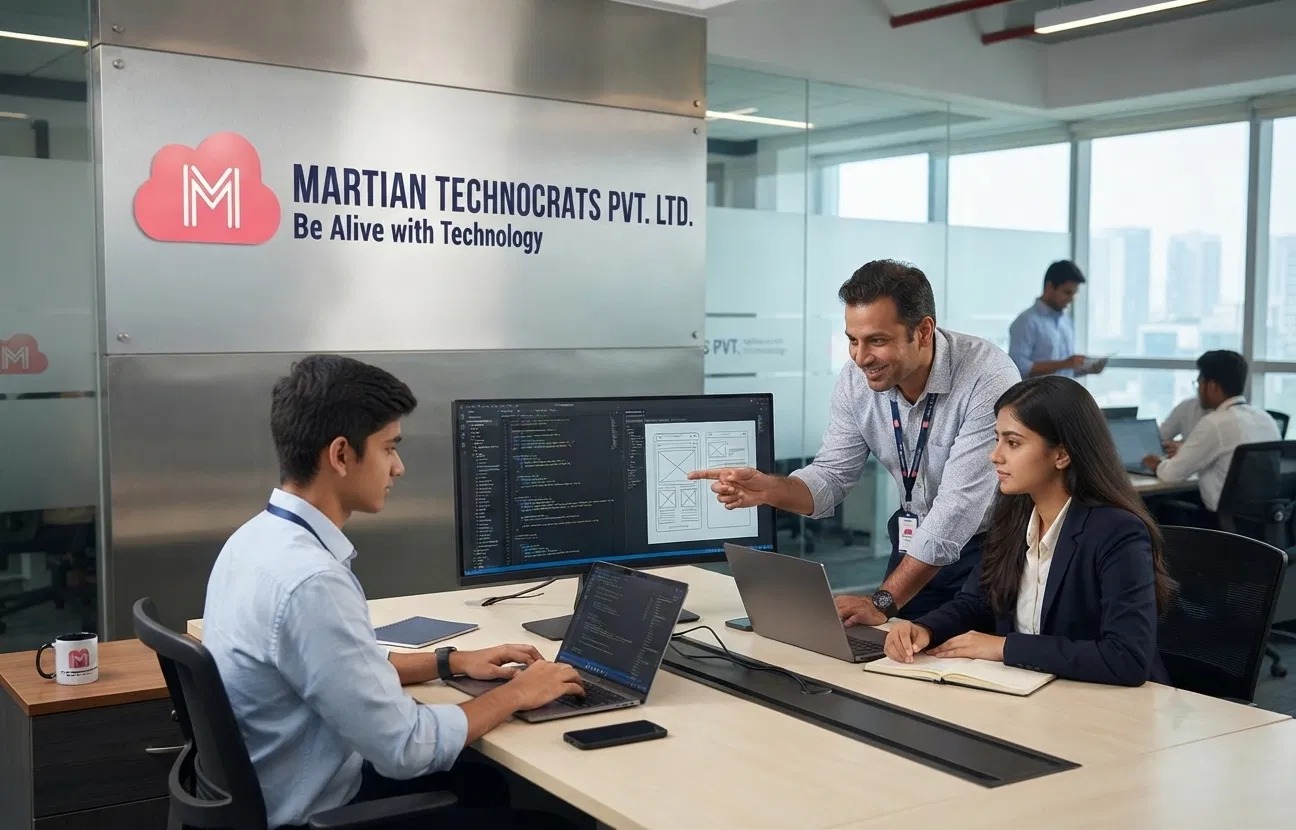
Mentor guiding interns on a wireframe at Martian Technocrats office
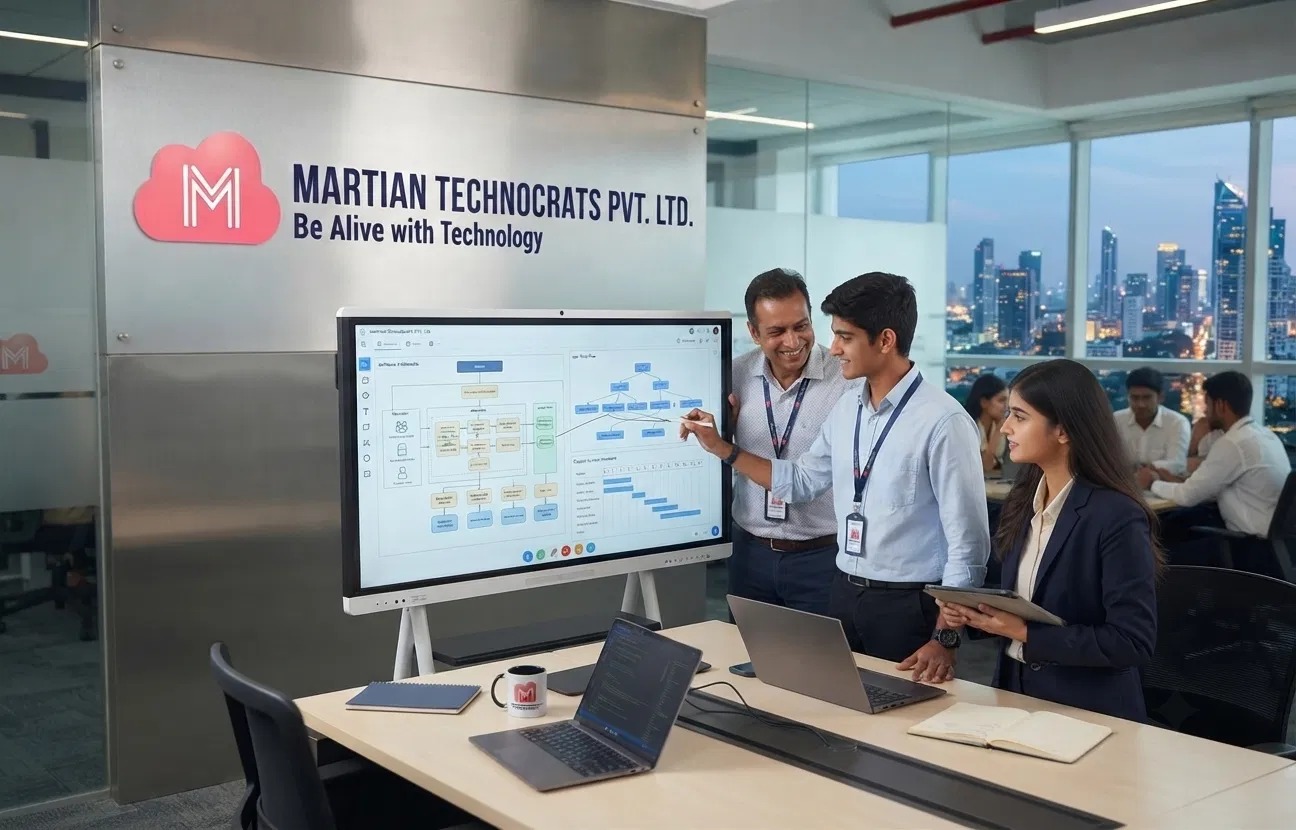
Team members reviewing a project plan on screen at Martian Technocrats

About the internship

Be alive with technology, from day one.

Our internship is designed to close the gap between classroom theory and what a real development team actually does. Interns are placed into small pods led by a senior developer, and spend their time writing code, debugging, and shipping features — the same workflow our client projects follow.

Whether you are aiming to become a software developer, a front-end or full-stack engineer, or an SEO specialist, you will leave with a portfolio of real work, not just a certificate.

  • Structured curriculum with weekly milestones
  • Direct mentorship from working developers
  • Exposure to live and simulated client projects
  • Offline at our Vadodara office, or online from anywhere
  • Certificate and letter of recommendation on completion

What you will learn

Every language our own teams build with.

These are the exact technologies our in-house developers use for client projects — and the ones you will train on during your internship. Each one is taught through hands-on tasks and small projects, not just slides.

Programming fundamentals

These languages teach you how software actually works: memory, logic, data structures and object-oriented design. Once you are comfortable here, every other language gets easier to pick up.

C

The foundation of modern programming

C is the language behind operating systems, embedded devices and many of the tools developers use every day. Learning it shows you how a program really runs — how variables sit in memory, how functions call each other and how data is laid out — which makes every later language easier to understand.

What you will learn

  • Data types, operators and control flow (if, switch, loops)
  • Functions, recursion and modular program design
  • Arrays, strings and pointers, and how memory works
  • Structures, file handling and dynamic memory allocation

You will build: Console programs such as a student record system, a simple bank ledger and number-pattern generators.

C++

Performance and object-oriented design

C++ builds on C with object-oriented programming and a rich standard library. It is used where speed matters — game engines, desktop software, trading systems and competitive programming — and it is an excellent way to learn how large programs are organized.

What you will learn

  • Classes, objects, constructors and encapsulation
  • Inheritance, polymorphism and operator overloading
  • The Standard Template Library: vectors, maps, sets and algorithms
  • Data structures such as stacks, queues and linked lists, plus file handling

You will build: Object-oriented projects like a library management system, an inventory manager and a text-based game.

Java

Object-oriented, enterprise-grade programming

Java is a strongly typed, object-oriented language that runs on the Java Virtual Machine, so the same code works on Windows, Linux and macOS. It powers enterprise back-ends, banking software and Android apps, and is valued for its structure and reliability.

What you will learn

  • Core syntax, classes, interfaces and packages
  • Exception handling, generics and the collections framework
  • File I/O and the basics of multithreading
  • Connecting Java programs to a database with JDBC

You will build: Applications such as an employee management system, a quiz app and a database-backed billing tool.

Python

Readable, versatile and quick to build with

Python's clean syntax makes it one of the best first languages, yet professionals use it for web back-ends, automation, data analysis and AI. In the internship it is used to build logic quickly, automate repetitive work and create small useful tools.

What you will learn

  • Variables, data types, lists, dictionaries and functions
  • File handling, modules and error handling
  • Object-oriented programming in Python
  • Automation scripts and working with APIs and JSON data

You will build: Projects such as a file-organizer script, an expense tracker and a data-cleaning tool.

Web front-end

Everything a visitor sees and touches in the browser. Together, these five technologies take you from a blank file to a finished, responsive website.

HTML5

The structure of every web page

HTML5 defines the content and structure of a page: headings, text, images, forms and links. Written semantically, it makes pages accessible to screen readers and easier for search engines to understand, which is why we treat it as the base of both development and SEO.

What you will learn

  • Semantic tags: header, nav, main, section, article and footer
  • Forms, input types and built-in validation
  • Images, audio, video and responsive media
  • Accessibility basics and SEO-friendly markup

You will build: A multi-page business website and an online application form.

CSS3

Layout, styling and motion

CSS3 controls how a page looks — colors, typography, spacing and layout — and how it adapts from a phone to a widescreen monitor. Modern CSS lets you build complex layouts and smooth animations without any extra libraries.

What you will learn

  • Selectors, the box model and specificity
  • Flexbox and CSS Grid for page layouts
  • Media queries and mobile-first responsive design
  • Transitions, animations and CSS variables

You will build: A responsive landing page built from a designer's mockup.

JavaScript

Makes web pages interactive

JavaScript is the programming language of the browser. It reacts to clicks and typing, validates forms, fetches live data and updates a page without reloading it. It is also the foundation for React, and through Node.js it runs on servers too.

What you will learn

  • Variables, functions, arrays, objects and modern ES6+ features
  • DOM manipulation and event handling
  • Form validation and working with JSON
  • The Fetch API, promises and async/await

You will build: A to-do app, an image slider, a live form validator and a weather widget that reads real data.

Bootstrap 5

Rapid, responsive UI building

Bootstrap is a ready-made set of layout, form and component styles for building clean, responsive pages quickly. It is the framework this very page is built with, and it is widely used for business websites and admin panels.

What you will learn

  • The 12-column grid system and breakpoints
  • Navbars, cards, modals, accordions and forms
  • Utility classes for spacing, color and alignment
  • Customizing Bootstrap so your site does not look like a template

You will build: A responsive company website and an admin dashboard layout.

React JS

Component-based front-ends

React is a JavaScript library for building interactive interfaces out of small, reusable components. Many modern web apps and single-page applications are built with it, and it is the natural next step once you know JavaScript well.

What you will learn

  • JSX, components and props
  • State and hooks such as useState and useEffect
  • Forms, lists and conditional rendering
  • Routing between pages and fetching data from an API

You will build: A task manager, a product list with search and filters, and a small dashboard.

Back-end and databases

The part users never see but always depend on: logic that runs on the server, and the database where the application's data lives.

PHP

Server-side logic for dynamic websites

PHP runs on the server and turns static pages into working applications: login systems, contact forms that send email, admin panels and content management. It powers a very large share of the web, including WordPress.

What you will learn

  • PHP syntax, arrays, functions and sessions
  • Handling forms securely with validation and input sanitizing
  • Sending email and uploading files
  • CRUD applications with MySQL, plus login and registration systems

You will build: A login system, a student registration portal and an admin panel with add, edit and delete.

MySQL

Storing and querying data

MySQL is a relational database that keeps an application's data in organized tables. Good database design keeps data accurate and queries fast, and it is a skill every back-end and full-stack developer needs.

What you will learn

  • Designing tables with primary and foreign keys
  • SELECT, INSERT, UPDATE and DELETE queries
  • Joins, grouping, filtering and sorting
  • Normalization, indexes and connecting MySQL to PHP

You will build: The database behind a student management or online ordering system.

Tools and growth

The professional tools around the code: how teams collaborate, how content-driven sites are delivered, and how websites get found on Google.

Git & GitHub

Version control for real teams

Git tracks every change made to a codebase, and GitHub is where teams share and review that work. Interns use both from the first week, the same way our developers do on client projects, so it is never a surprise at a job interview.

What you will learn

  • Repositories, commits and branches
  • Merging code and resolving conflicts
  • Pull requests and code reviews
  • Building a public GitHub profile from your projects

You will build: Every internship project lives in your own repository, which becomes your portfolio.

WordPress

CMS-driven websites

WordPress is the most widely used content management system in the world. Businesses choose it because non-technical staff can update their own site. You will learn to set up, customize and maintain WordPress sites and understand what happens under the hood.

What you will learn

  • Installing WordPress, choosing themes and using page builders
  • Plugins, menus, widgets and media management
  • Customizing themes with HTML, CSS and PHP
  • Security, backups and basic performance settings

You will build: A complete business website with a blog and a contact form.

SEO

Getting websites found on Google

Search engine optimization helps a website rank on Google so the right people can find it. It combines technical clean-up, useful content and link building, and it pairs naturally with web development.

What you will learn

  • Keyword research and search intent
  • On-page SEO: titles, meta descriptions, headings and internal links
  • Technical SEO: site speed, mobile-friendliness, sitemaps and structured data
  • Reading Google Search Console and Analytics reports

You will build: An SEO audit and improvement plan for a real website.

Not sure where to begin? Most beginners start with C or Python to build logic, and HTML, CSS and JavaScript for the web. You do not need to learn everything — pick a track in the application form and your mentor will place you at the right level.

How it works

From application to offer letter.

Step 1

Apply

Send your details and preferred track through the application form below, by email, or with a phone call.

Step 2

Screening call

A short conversation to understand your background, interest and availability.

Step 3

Onboarding

Get access to your track curriculum, tools, and an assigned mentor from day one.

Step 4

Build & graduate

Ship your project, get evaluated, and receive your certificate and recommendation letter.

Apply now

Ready to start building?

Fill in your details below and our team will reach out to guide you through the next steps.

Please enter your name.
Please enter a valid email.
Please enter a valid phone number.
Please enter your city.
Please enter your college or university.
Please enter your course and year.
Please select a track.
Please choose a mode.

Questions

Internship FAQs

Students and freshers from computer science, IT, or any related background can apply. Whether you are in college, a recent graduate, or self-taught, what matters most is your interest in learning to build real software.

Most tracks run between 4 and 12 weeks depending on your chosen technology and project depth. We also offer flexible short-term and extended long-term options for students on different schedules.

Select performance-based tracks include a stipend. Every intern, regardless of track, receives a completion certificate and a letter of recommendation for strong performance.

Depending on your track, you will work with C, C++, Java, Python, HTML5, CSS3, JavaScript, Bootstrap, React, PHP, MySQL, Git & GitHub, WordPress and SEO tools — the same stack our development team uses for client work. The full list, with what each one covers, is in the languages section above.

No. Beginner tracks start from the fundamentals and build up gradually. If you already have some experience, we place you at a level that matches your current skill so you keep progressing.

Yes. Every intern who completes their assigned project and final evaluation receives an official internship completion certificate from Martian Technocrats Pvt. Ltd.

Both. You can intern in person at our Vadodara office or remotely online, whichever suits your location and schedule better.

Use the application form above, email your resume to info@martianinstitute.com, or call us directly at +91 7990752290. You can also visit our office in Vadodara in person.

Once you're comfortable with the fundamentals, you're assigned tasks on real or simulated client projects, always under the guidance of a senior developer on our team.

Yes. Top-performing interns are strongly considered for full-time roles at Martian Technocrats Pvt. Ltd. based on their skill growth, attitude and consistency during the program.