Introduction to Python Programming Course in Vadodara by Martian Institute


What is Python ?
High-level, interpreted, object-oriented, and dynamically interpreted Python is a programming language. Its dynamic typing and dynamic binding, together with its high-level built-in data structures, make it an appealing language for Rapid Application Development and for usage as a scripting or glue language to join existing components. Python prioritizes readability and hence lowers the cost of software maintenance because of its clear, understandable syntax. Python's support for modules and packages promotes code reuse and program modularity. All major platforms offer free source or binary versions of the Python interpreter and the large standard library, which may be shared without restriction.
Why do I need Python Programming Course :
- Career Advancement: Python skills are in high demand in industries like data science, machine learning, web development, and automation.
- Improve Problem-Solving Skills: Python teaches logical thinking, algorithmic approaches, and breaking down complex problems.
- Enhance Data Analysis Skills: The Pandas, NumPy, and Matplotlib packages for Python facilitate effective data processing and visualization.
- Web Development: Frameworks like Django and Flask enable rapid web development.
- Artificial Intelligence and Machine Learning: Python's libraries (TensorFlow, Keras, Scikit-learn) facilitate AI and ML development.
- Automation: Python automates tasks, increasing productivity.
- Scientific Computing: Python's libraries (NumPy, SciPy) support scientific simulations and data analysis.
- Education: Python introduces programming concepts, making it an ideal teaching language.
Overview :
Python is a high-level interpreted programming language that is simple to learn and comprehend. It's a versatile language used for:
- Web development
- Data analysis and science
- Machine learning and AI
- Automation and scripting
- Scientific computing
- Education
Key Features :
- Simple syntax
- Dynamic typing
- Object-oriented
- Large standard library
- Cross-platform compatibility
- Extensive community support
Python Strengths :
- Easy to learn and teach
- Rapid development and prototyping
- Versatile and adaptable
- Extensive libraries and frameworks
- Large and active community
- Cross-industry applications
Python Applications :
- Web Applications
- Desktop GUI Applications
- Console-based Application
- Software Development
- Scientific and Numeric
- Business Applications
- Audio or Video-based Applications
- 3D CAD Applications
- Enterprise Applications
- Image Processing Application
Python Career Paths :
- Python developer
- Data analyst/scientist
- Machine learning engineer
- Web developer
- Automation engineer
- Research scientist
Why Learn Python ?
- High demand in industry
- Versatile skillset
- Easy to learn
- Large community support
- Cross-industry applications
- Constantly evolving and improving
Python Versions :
- Python 2.x (legacy)
- Python 3.x (current)
Objective :
Beginner Level :
- Understand basic syntax and data types.
- Learn control structures (if/else, loops).
- Master functions, modules, and file input/output.
- Understand data structures (lists, tuples, dictionaries).
- Develop problem-solving skills.
Intermediate Level :
- Learn object-oriented programming (OOP) concepts.
- Understand web development basics (Flask/Django).
- Develop skills in data analysis and visualization (Pandas, NumPy, Matplotlib).
- Learn machine learning fundamentals (Scikit-learn).
- Understand database interactions (SQL/NoSQL).
Career-Oriented Objectives :
- Prepare for roles like Python developer, data scientist, machine learning engineer.
- Develop industry-specific skills (web development, data analysis, automation).
- Learn best practices for coding, testing, and deployment.
- Understand industry trends and emerging technologies.
- Develop soft skills like communication, teamwork, problem-solving.
Personal Project Objectives :
- Apply Python skills to real-world projects.
- Develop a personal project portfolio.
- Showcase projects on platforms like GitHub.
- Receive feedback from mentors and peers.
- Continuously improve and refine projects.
Career Opportunities :
Python Developer :
- Create automation scripts, online apps, and data analysis tools.
- Average salary: $114,140/year (USA).
Data Scientist :
- Analyze and interpret complex data using Python libraries like Pandas, NumPy, and Matplotlib.
- Average salary: $118,370/year (USA)..
Machine Learning Engineer :
- Develop predictive models and AI solutions using TensorFlow, Keras, and Scikit-learn.
- Average salary: $141,800/year (USA).
Web Developer :
- Build web applications using Django, Flask, and Pyramid.
- Average salary: $73,950/year (USA).
Automation/DevOps Engineer :
- Automate tasks and processes using Python scripts and tools like Ansible.
- Average salary: $115,120/year (USA).
Data Analyst :
- Use Python packages such as NumPy, Matplotlib, and Pandas to analyze and visualize data.
- Average salary: $60,460/year (USA).
Scientific Computing Specialist :
- Develop simulations, models, and data analysis tools for scientific research.
- Average salary: $95,450/year (USA).
Business Intelligence Developer :
- Build data visualizations and reports using Python libraries like Matplotlib and Seaborn.
- Average salary: $95,500/year (USA).
Research Scientist :
- Use Python programming for science projects in biology, physics, and economics, among other subjects.
- Average salary: $85,000/year (USA).
Artificial Intelligence/Machine Learning Researcher :
- Explore new AI/ML techniques and develop innovative solutions using Python.
- Average salary: $125,000/year (USA).s
Industry-Wise Opportunities :
- Finance and Banking
- Healthcare and Biotechnology
- Scientific Research and Academia
- Web Development and IT
- Data Science and Analytics
- Artificial Intelligence and Machine Learning
- Automation and DevOps
- Education and Training
- Government and Public Sector
- Consulting and Services
Python Applications :
Python is known for being a general-purpose language that can be used in practically any field of software development. Python is present in all developing fields. It can create any application and is the programming language with the quickest growth rate.
Here, we're presenting some potential areas of use for Python.
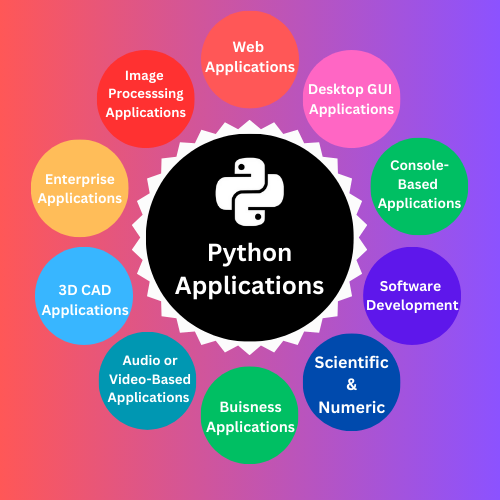
Web Applications :
Python is a helpful program for making web applications. It offers libraries to manage emails, requests, beautifulSoup, feedparser, HTML and XML, JSON, and so on. Instagram makes use of the Python web framework Django. Numerous helpful frameworks are available for Python, some of which are listed here :
- (Use for large applications) Django with Pyramid framework.
- Bottle and Flask (Micro-framework)
- Django CMS (Advanced Content management) with Plone
Desktop GUI Applications :
The Graphical User Interface, or GUI, makes any application easy to use. To create a user interface, Python comes with a Tk GUI framework. The list of well-known GUI libraries is provided below.
- Tkinter or Tk
- wxWidgetM
- Kivy (used for writing multitouch applications )
- PyQt or Pyside
Console-based Application :
Applications that operate on a console do so via a shell or command line. These programs are computer programs that are run via commands. The older computer generations saw a greater use of this type of application. This is the type of application that Python can create really well. The Read-Eval-Print Loop, or REPL, is what makes it so well-known and makes it the best language for command-line applications.
Python offers lots of free libraries and modules that facilitate the development of command-line programs. Reading and writing need the usage of the required IO libraries. It is useful for automatically analyzing arguments and generating console help messages. Advanced libraries are also capable of creating stand-alone console applications.
Software Development :
Python is helpful in the process of developing software. It may be used to develop control and management, testing, and other tasks as a support language.
- SCons is used to build control.
- The tools used for automated continuous compilation and testing are Buildbot and Apache Gumps
- For project management and bug tracking, use Round or Trac.
Scientific and Numeric :
In this day of artificial intelligence, a computer can carry out a work just as well as a person. Python is the greatest language for artificial intelligence and machine learning. Its abundance of scientific and mathematical research facilitates the resolution of challenging computations.
Complex mathematical calculations are needed to implement machine learning algorithms. Numerous scientific and numeric libraries, including Numpy, Pandas, Scipy, Scikit-learn, and others, are available for Python. You must import libraries at the start of the code if you know even the fundamental syntax of Python. Below is a list of a few popular machine library frameworks.
- SciPy
- Scikit-learn
- NumPy
- Pandas
- Matplotlib
Business Applications :
Business apps and standard apps are not the same. E-commerce and ERP are two examples of business applications. Python has all the qualities that this type of application needs, including readability, scalability, and complex requirements.
One example of an all-in-one Python program that provides a variety of commercial applications is Oddo. The Tryton platform, made available by Python, is used to create commercial applications.
Audio or Video-based Applications :
Python may be used for many different tasks and can be used to create multimedia applications. Python-based apps include multimedia packages like cplay and TimPlayer. Below are a few multimedia libraries.
- Gstreamer
- Pyglet
- QT Phonon
3D CAD Applications :
Architectural design connected to engineering is done with the use of computer-aided design, or CAD. It is employed to create a system's component's three-dimensional representation. These functions may be used by Python to develop a 3D CAD application.
- Fandango (Popular )
- CAMVOX
- HeeksCNC
- AnyCAD
- RCAM
Enterprise Applications :
Applications that may be utilized within a business or organization can be made with Python. Tryton, Picalo, OpenERP, and others are examples of real-time applications.
Image Processing Application :
There are several libraries in Python that are needed to interact with the picture. It is possible to alter the picture to suit our needs. Below are a few image processing libraries.
- OpenCV
- Pillow
- SimpleITK
Introduction :
One well-liked programming language is Python. Guido van Rossum developed it, and it was published in 1991.
It is used for:
- web development (server-side)
- software development,
- mathematics
- system scripting
Conditional Statements :
Basic programming elements known as conditional statements (if, else, and elif) let you regulate how your program runs depending on the circumstances you set. They provide you the ability to decide in your program and run alternative code according to those options.
Looping :
Looping is the process of repeating an action repeatedly until a certain condition is met. In Python, a for loop is a control flow statement that is used to carry out a set of instructions repeatedly in the event that a condition is met. An iterative statement is another term for this kind of declaration.
Control Statements :
To sum up, control statements in Python are employed to manage the course of a program's execution. There are three different kinds of control statements: pass, continue, and break. These statements enable error handling, performance optimization, and the selective execution of particular sections of code depending on specific requirements.
String Manipulation :
In summary, string manipulation in Python includes a range of actions to change and handle strings, such as formatting, slicing, concatenating, searching, and changing case. In Python applications, these processes are necessary for text processing, data manipulation, and dynamic content generation.
Lists :
Overview. In Python, a list is an ordered series of items that may be changed or modified. Items are all the values or elements that make up a list. Lists are defined by having values between square brackets [], just as strings are defined as characters between quotations.
Tuple :
Multiple things can be stored in a single variable by using tuples. One of Python's four built-in data types, tuples are used to hold collections of data. The other three, list, set, and dictionary, have various properties and applications. A tuple is an unchanging, ordered collection.
Dictionaries :
Dictionary data structures in Python are mutable and let you store key-value pairs. Curly braces' {}' or the dict() constructor can be used to create dictionaries. Once a dictionary has been established, you may use the dict. update(), dict. pop(), and dict methods to add, delete, or update items.
Functions :
A function is a code block that executes only when it is invoked. A function can accept arguments, which are data. This can lead to a function returning data.
Modules :
Modules in Python are just files with the extension ".py" that contain Python code and can be imported into other Python Modules Operations Programs. To put it simply, a module is the same as a code library or a file that has a collection of functions you wish to use in your program.
Input-Output :
After receiving input in Python and processing it, a program must return the processed data to the user as output. The output data can be shown directly on the console (or IDE) or via a graphical user interface (GUI) on a screen. Even sending it back to a different source is an option.
Exception Handling :
Errors that happen while the program is running during runtime are known as exceptions. They are typically the result of improper user input or improper Python code. With exception handling, an error can happen and the application can still run.
OOPs Concept :
Object-oriented programming, or OOPs for short, is a paradigm for writing Python programs that makes use of classes and objects. Python concepts known as inheritance, polymorphisms, encapsulation, and other real-world concepts are intended to be implemented in programming through OOPs.
Regular Expressions :
Syntax for Regular Expressions. The methods in this module allow you to determine if a given string matches a given regular expression (or, more accurately, whether a given regular expression matches a certain string). A regular expression (or RE) gives a list of strings that match it.
CGI :
It is not a language; rather, Common Gateway Interface, or CGI for short, is a specification (set of rules) that enables dynamic communication between a web application and the browser (or client application). CGI programs are what enable the connection between the client and the server.
Database :
A database in Python is a file that contains data arranged for easy access. The database is permanent even after the software terminates since it is saved on disk or another permanent storage medium, much like a dictionary. Any kind of data, including text, numbers, pictures, videos, and files, may be kept in databases.
Networking :
The goal of Python Network Programming is to manage computer networking needs by utilizing Python as a programming language. For instance, suppose we wish to set up and manage a local web server or download certain files regularly from a pattern-matching URL.
Multithreading :
In order to prevent one longer-running process from blocking all the others, programs can generate many threads with execution cycling among them. This technique is known as multithreading (often just "threading"). This is effective for activities that can be divided into more manageable subtasks, each of which may be assigned to a thread for completion.
GUI Programming :
An interface that lets people interact with software is called a Python GUI, or Graphical User Interface. It gives users a collection of graphical elements—such as sliders, dropdown options, buttons, and checkboxes—to perform a range of activities and access different program features.
Sending Email :
Python offers the sendmail() method, which performs exactly what its name implies—it sends email. The sendmail() method has the following syntax: sendmail(message, sender_email, and recipient_email) sender_email: the sender's email address. receiver_email: The recipient's email address.
One to One Training
Software Provided
Fees on EMI


